
Feeling Distant From Your Partner? 7 Signs of Emotional Disconnection
You still live together. You still function as a family. But somewhere along the way, something went quiet
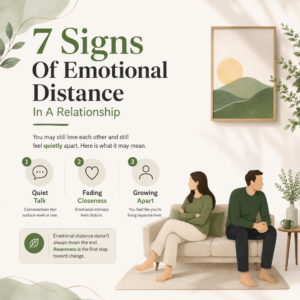 You don’t fight as much anymore — but you don’t really talk much either. You know the kids’ schedules, the grocery list, the EMI due date. What you don’t always know anymore is what’s happening in each other’s hearts.
This is emotional distance. And it rarely announces itself with a dramatic moment. It builds quietly — through conversations skipped, feelings left unexplained, and hugs that become less frequent.
As a relationship therapist, this is one of the most common patterns I see in couples therapy. And here’s the key insight: emotional distance doesn’t always mean love is gone. Often, it means emotional safety is gone.
What Is Emotional Distance?
Emotional distance is the gradual loss of closeness between two people who are still, on paper, a couple. The house runs. The kids are cared for. You attend family events together. But you no longer feel emotionally reached by your partner.
Couples describe it like this:
- “We’re together, but I feel alone.”
- “We talk all day, but we don’t really talk.”
- “We’re more like partners in managing life than partners in living it.”
Most couples don’t notice the distance as it happens — only once they realize how long it’s been there.
The 7 Signs
1. You talk all day — but only about logistics. Pickup times, bills, weekend plans — that’s communication, not connection. Ask yourself: when did you last ask your partner how they’re really doing, not about work or the kids, but about them?
2. You stop sharing the small stuff. Something funny happens and you text a friend instead. A bad day, and you call your sibling first. None of this alone is a red flag — but notice who you naturally turn toward. Intimacy lives in small moments like “I thought of you when I saw this,” and when those disappear, distance grows.
3. Physical touch fades or becomes routine. Not just sex — hand-holding, sitting close, a hug that isn’t just “goodbye.” When touch disappears, it’s often an emotional safety problem wearing a physical disguise. One partner feels rejected; the other feels pressured. Both pull further away.
4. You stop fighting — and assume that’s progress. Sometimes. But sometimes couples stop fighting because they’ve stopped believing it’ll change anything. There’s a real difference between peace and resignation.
5. You feel like roommates, not partners. Bills paid, meals made, life “working” — but not feeling alive. Ask: if we removed the shared responsibilities, what would still connect us?
6. Your phone is more interesting than your partner. The screen doesn’t ask “what’s wrong?” It doesn’t require vulnerability. That’s exactly why it’s easier to reach for.
7. Your partner isn’t who you go to anymore. Good news, bad days, big feelings — they go elsewhere first. Having outside emotional support is healthy. But if your partner has quietly become the last person you turn to, it’s worth paying attention to.
Why This Happens
There’s rarely one cause — unresolved arguments, stress, parenting pressure, grief, or just years of small disconnects adding up. Often it traces back further: two people who learned very different things about handling hurt growing up. One learned to talk it out; the other learned to withdraw. One reaches, the other retreats — and both end up misreading the other as rejection.
This is why “communicate better” often isn’t the real fix. The deeper issue is usually what communication means to each partner.
Can It Be Repaired?
Often, yes — but not by trying to force romance back first. It usually starts with a harder question: “When did it stop feeling safe to be fully ourselves with each other?”
Repair typically involves:
- Learning to listen without getting defensive
- Understanding the pursue-withdraw pattern
- Naming resentments instead of burying them
- Rebuilding intimacy gradually, not all at once
When to Consider Couples Therapy
You don’t need to wait for a crisis. Consider it if you:
- Feel alone despite being together
- Keep having the same argument on repeat
- Have stopped feeling heard
- Have noticed intimacy fading — emotional or physical
- Have started imagining life outside the relationship
Therapy isn’t about deciding who’s right. It’s about creating enough safety to understand what’s actually happening between you.
The Real Question
Maybe it’s not “do we still love each other,” but “do we still know how to reach each other?” Love can stay present even when connection gets buried under exhaustion, routine, and things left unsaid.
About Prince Dhawan
I’m a Counselling Psychologist and Relationship Therapist working with individuals and couples on emotional disconnection, intimacy concerns, and recurring relationship patterns — in Delhi, Noida, and online.
Book a confidential session: www.princedhawan.com
FAQs
What are the signs of emotional distance in a relationship? Practical-only conversations, reduced affection, feeling unheard, and no longer turning to your partner for emotional support.
Is emotional distance a sign the relationship is over? Not necessarily — it’s often repairable once both partners understand the underlying pattern.
How do you reconnect emotionally with a partner? By getting curious about each other again, creating space for vulnerability, and understanding why one partner withdraws while the other pursues.
Can couples therapy help? Yes — it helps identify patterns, rebuild communication, and restore emotional intimacy without assigning blame.
When should a couple seek counselling? Anytime the same conflict keeps repeating or communication has broken down — you don’t need to wait for a crisis.